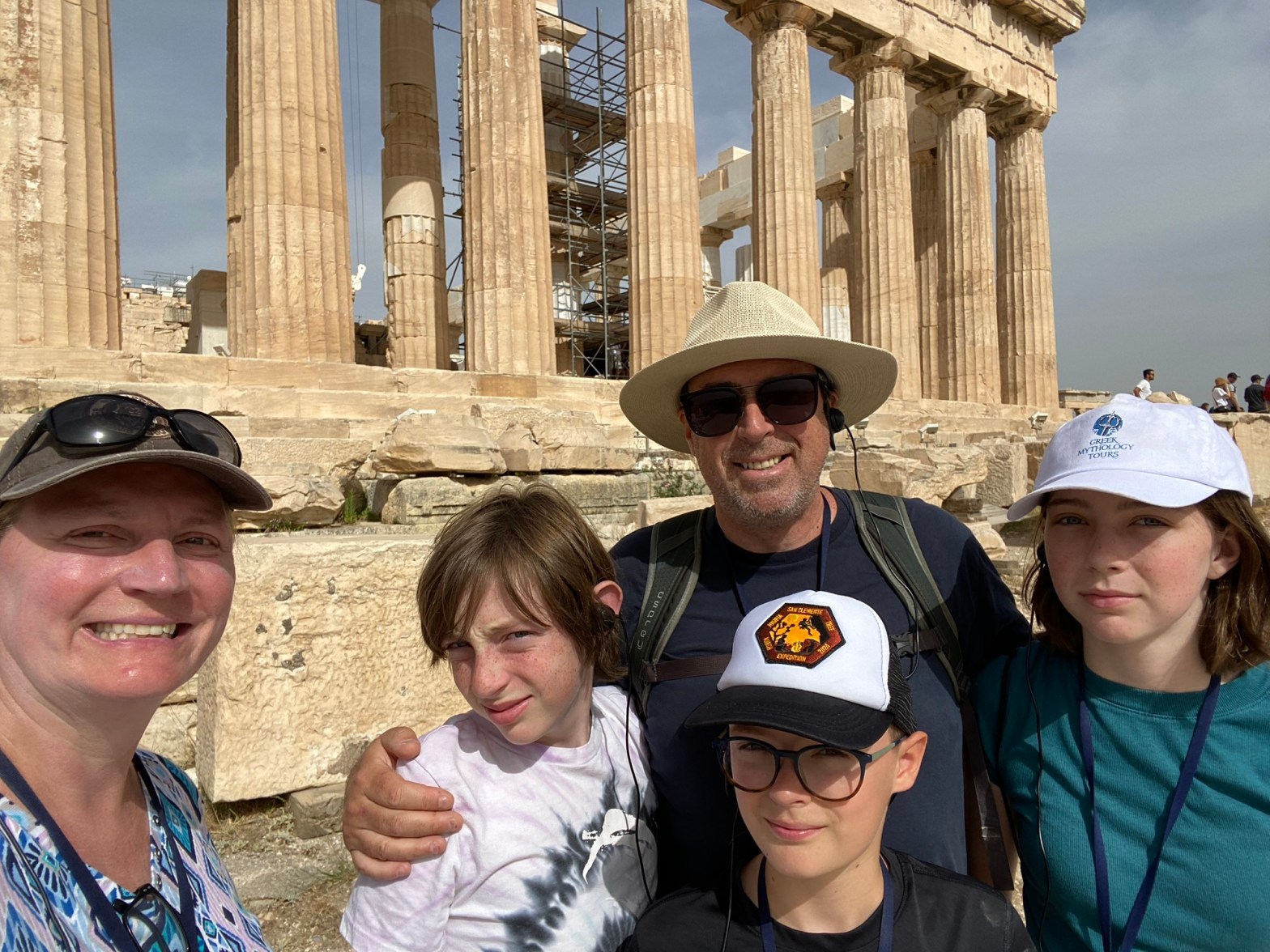
Athens is practically synonymous with the Acropolis and Parthenon, at least in the minds of current and former middle schoolers in the midst of a Greek mythology obsession.
In truth, Athens is a city of over 5 million people with lots going on besides its ancient history. Nevertheless, from the old neighborhoods of Athens Centre the Acropolis is so tall and imposing that it hovers over everything. We saw it walking home from our Temple of Poseidon tour on Day 1.
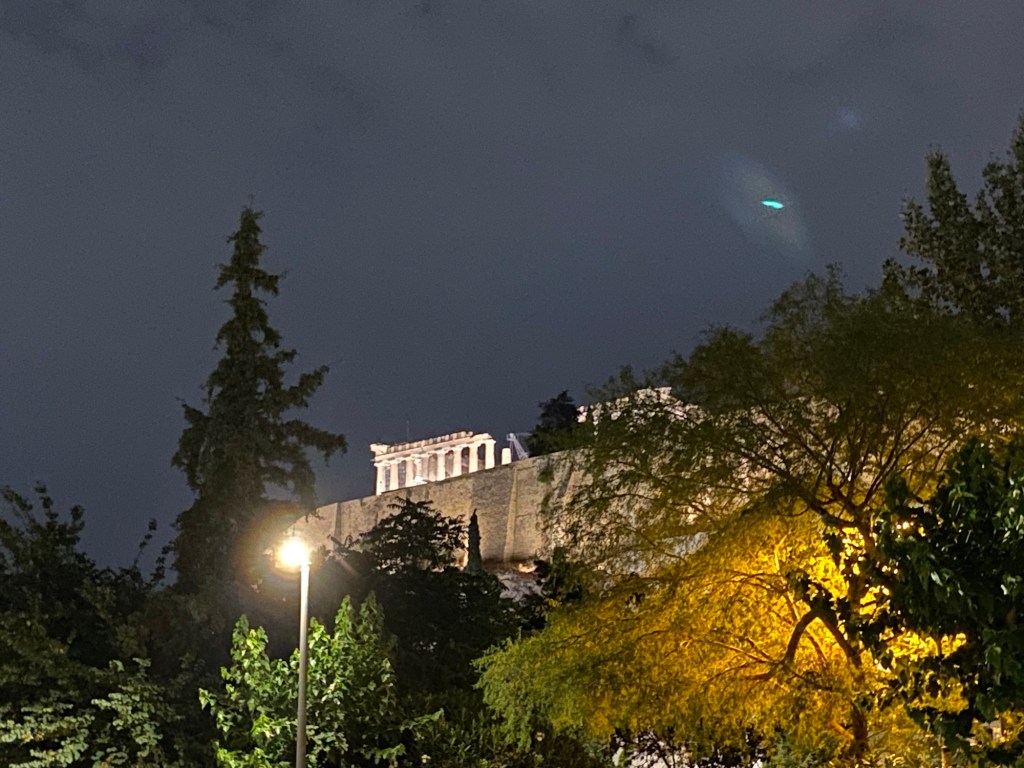
We also saw it on Day 2 from the Agora. In its heyday, you could walk from there up the steep hill to the monuments.
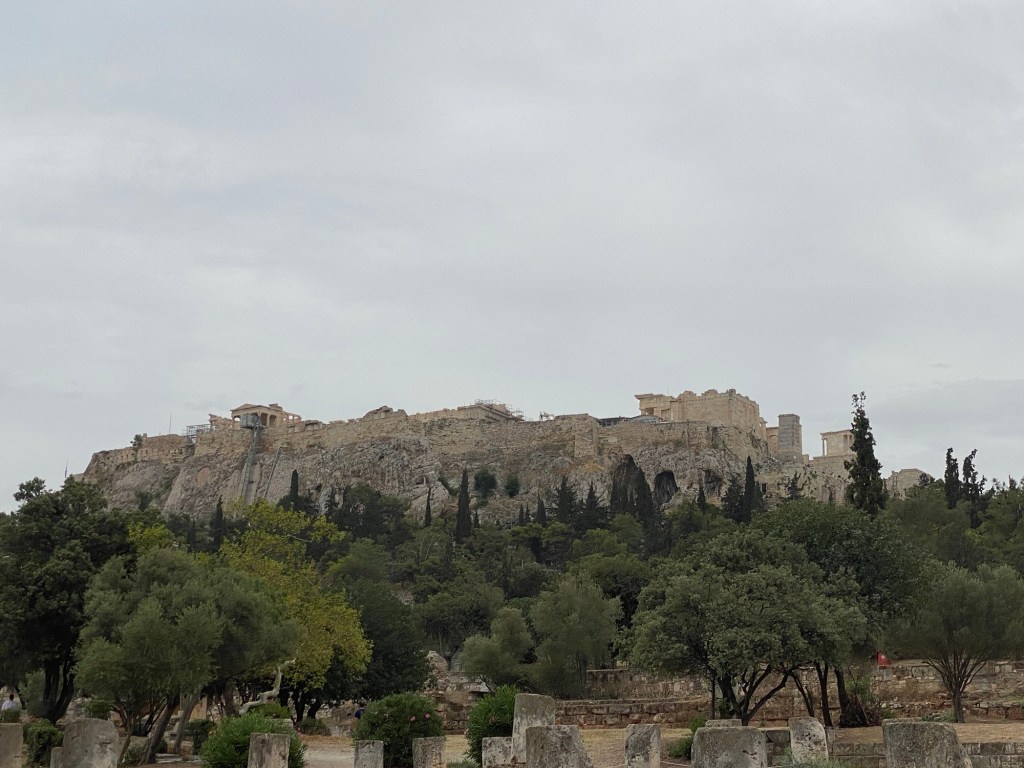
So today we finally made the hike up to see this masterpiece of Greek Art and Architecture up close.
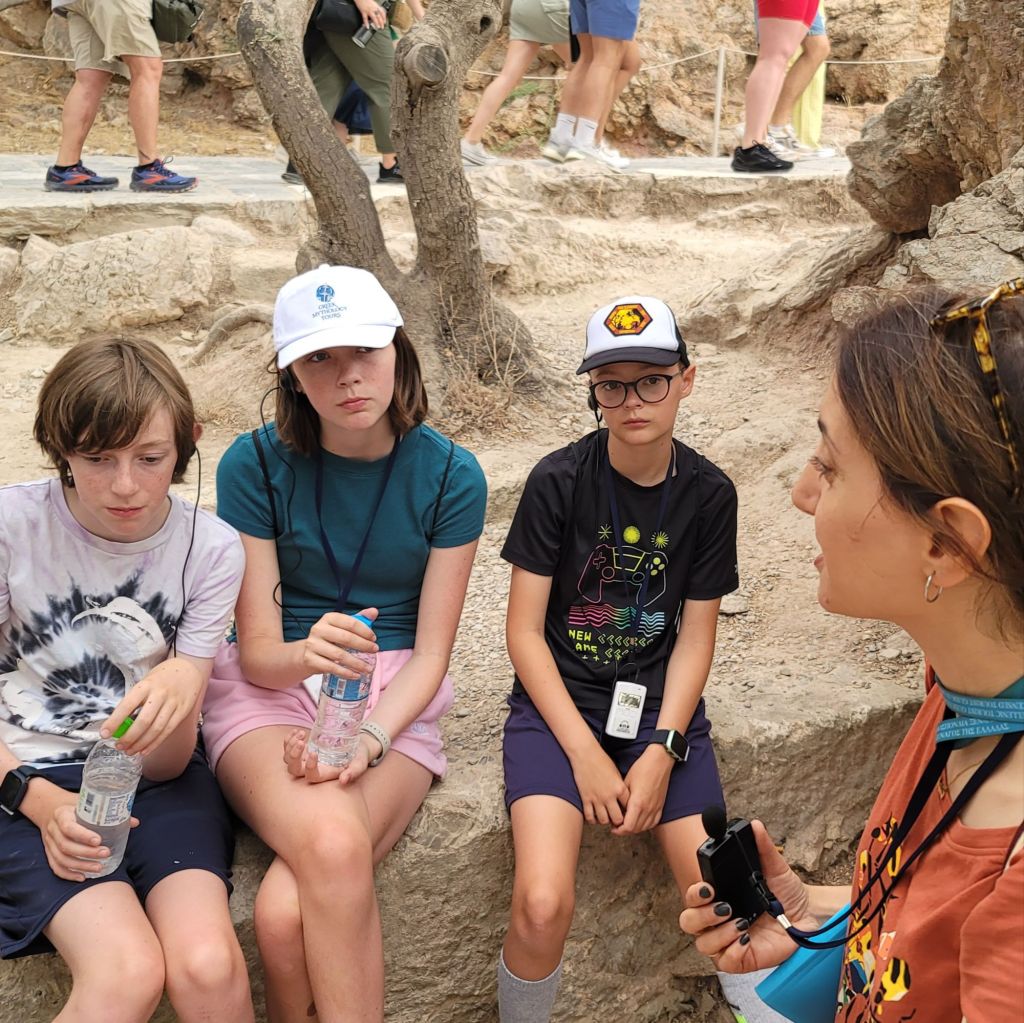
We joined a small group tour designed for families. It was billed as a Percy Jackson themed tour and the guide did a good job bringing relevant characters and parts of the books into her descriptions. Our kids were competing with three younger kids on who could be the most ‘know it all’ for mythology facts and all 6 kids held their own. Her approach kept them engaged through 3 hours in the heat and another hour at the museum which houses all the artifacts from the Acropolis
Often the Acropolis and Parthenon are used interchangeably but they are different. The Acropolis is the entire citadel on top of the hill – established for protection, worship etc. Pretty much every city in Ancient Greece had one.
To understand the unique significance of the Athens Acropolis, this summary from UNESCO covers it pretty well.
In the 5th century BC, the Athenians, empowered from their victory over the Persians, carried out an ambitious building programme under the leadership of the great statesman Perikles, comprising a large number of monuments including the Parthenon, the Erechtheion, the Propylaia and the temple of Athena Nike. The monuments were developed by an exceptional group of architects and sculptors who transformed the rocky hill into a unique complex, which heralded the emergence of classical Greek thought and art.
On this hill were born Democracy, Philosophy, Theatre, Freedom of Expression and Speech, which provide to this day the intellectual and spiritual foundation for the contemporary world and its values. The Acropolis’ monuments, having survived for almost twenty-five centuries through wars, explosions, bombardments, fires, earthquakes, sackings, interventions and alterations, have adapted to different uses and the civilizations, myths and religions that flourished in Greece through time.
We entered the hill as the Ancient Greeks did – by foot, up the western slope, through the Propylaia.

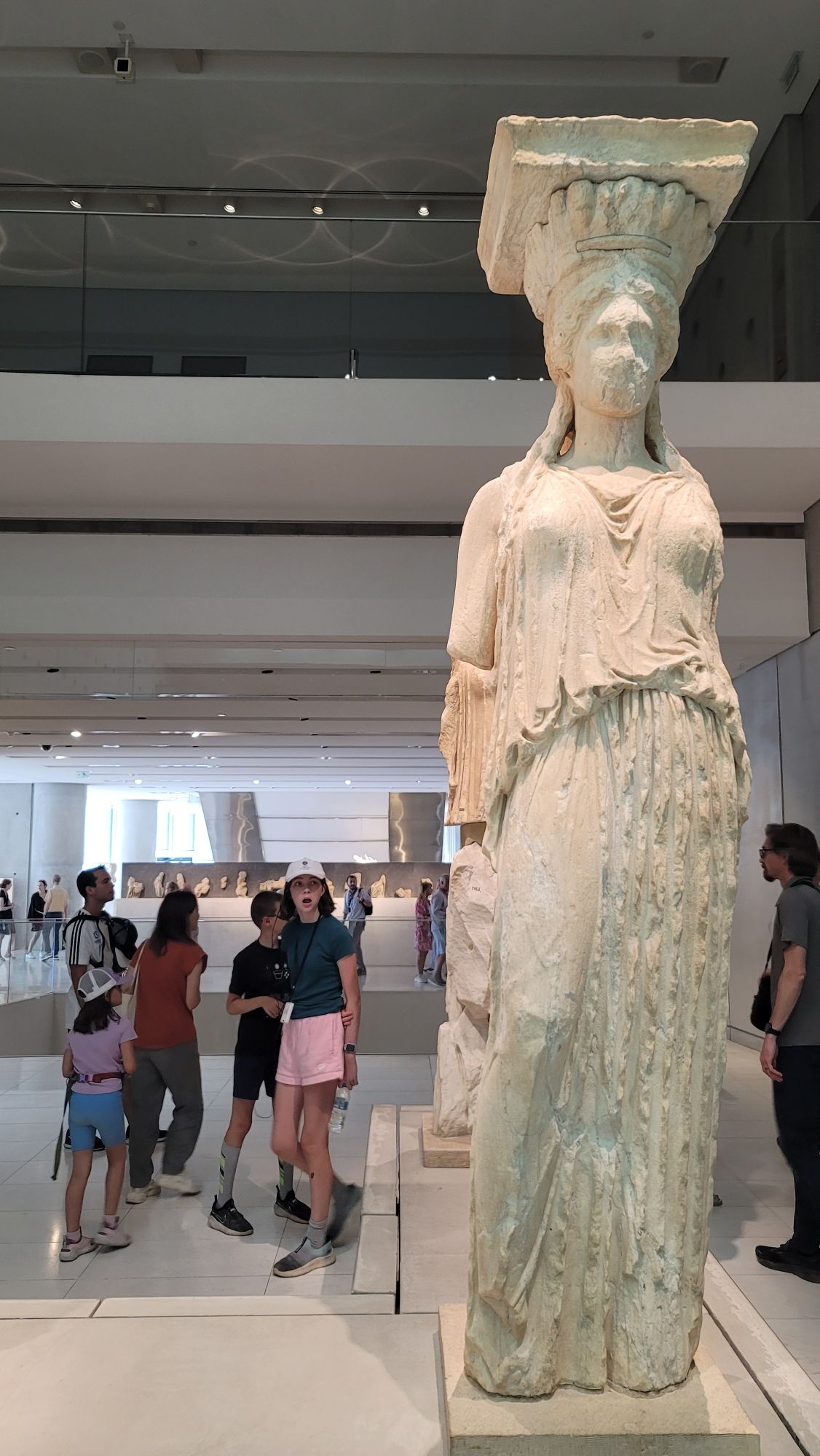
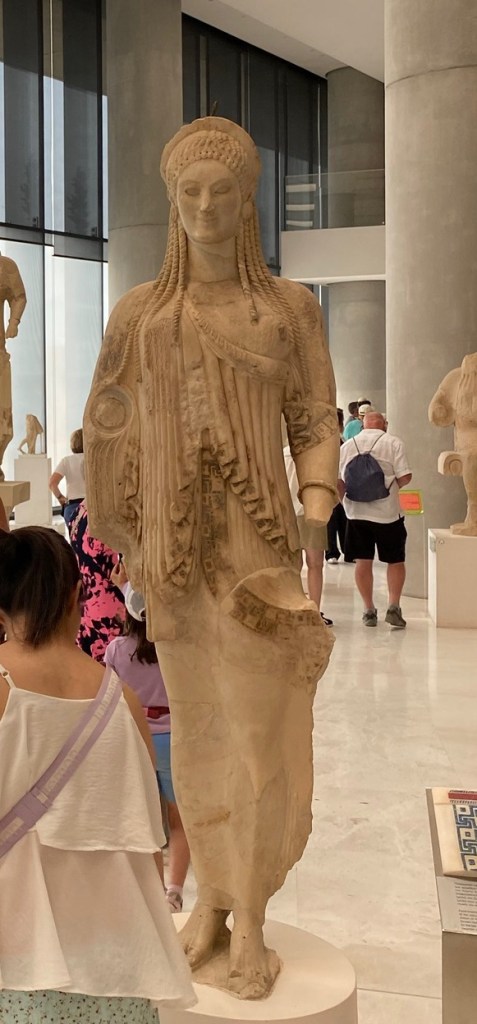
From there we admired the Temple dedicated to Nike, and the temple dedicated to Athena and Poseidon representing their gifts to the city: an olive tree and a salt water spring, respectively. In fact, there has been an olive tree growing beside this temple for almost 6000 years. Today it’s not Athena’s original tree, but one is always growing there to symbolize the story of how Athens picked her as their patron goddess. The female statues used as columns to support the ceiling were a unique aspect of this temple. We saw the temple with reproductions and then the originals in the Museum a short while later.
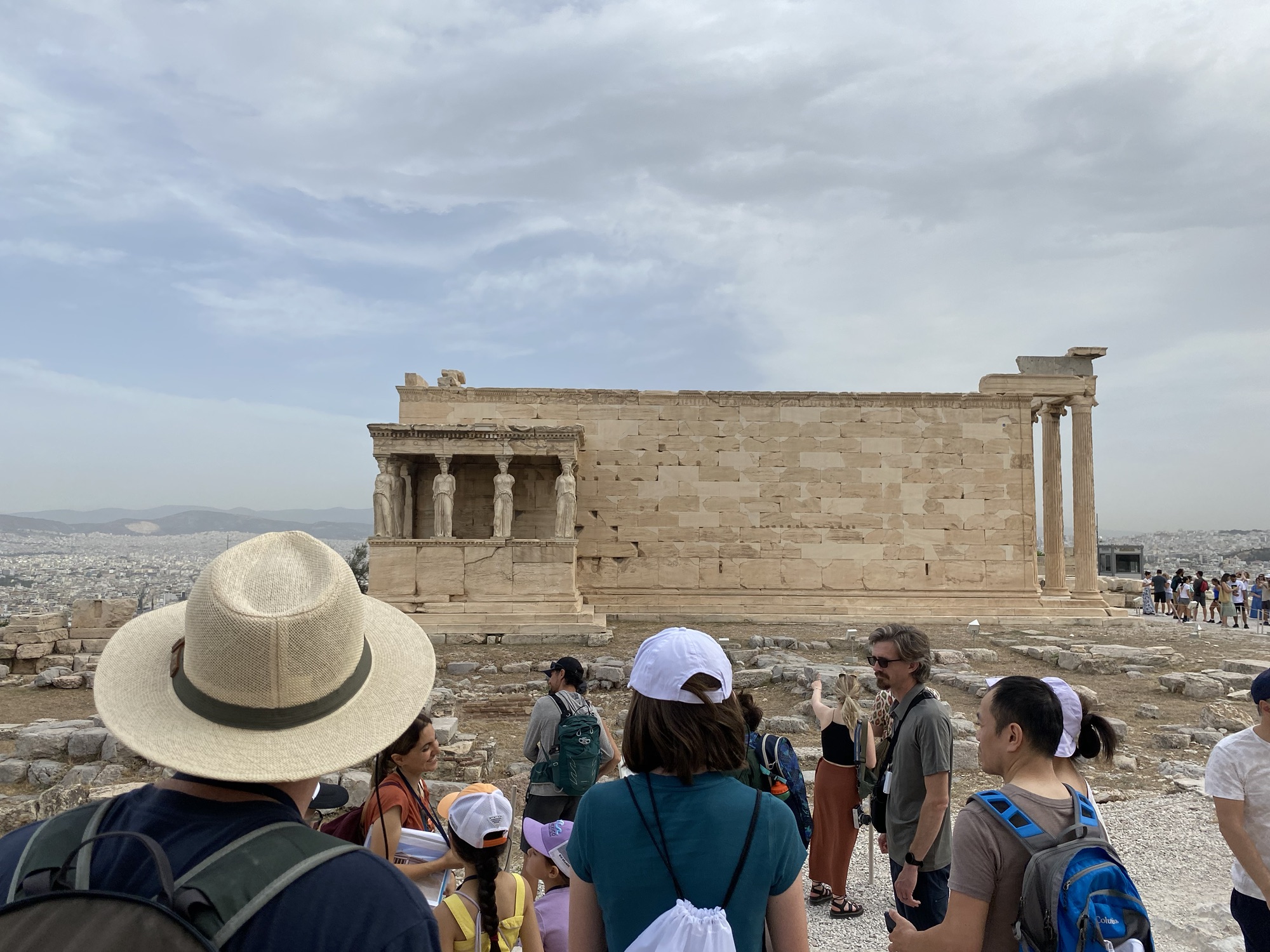
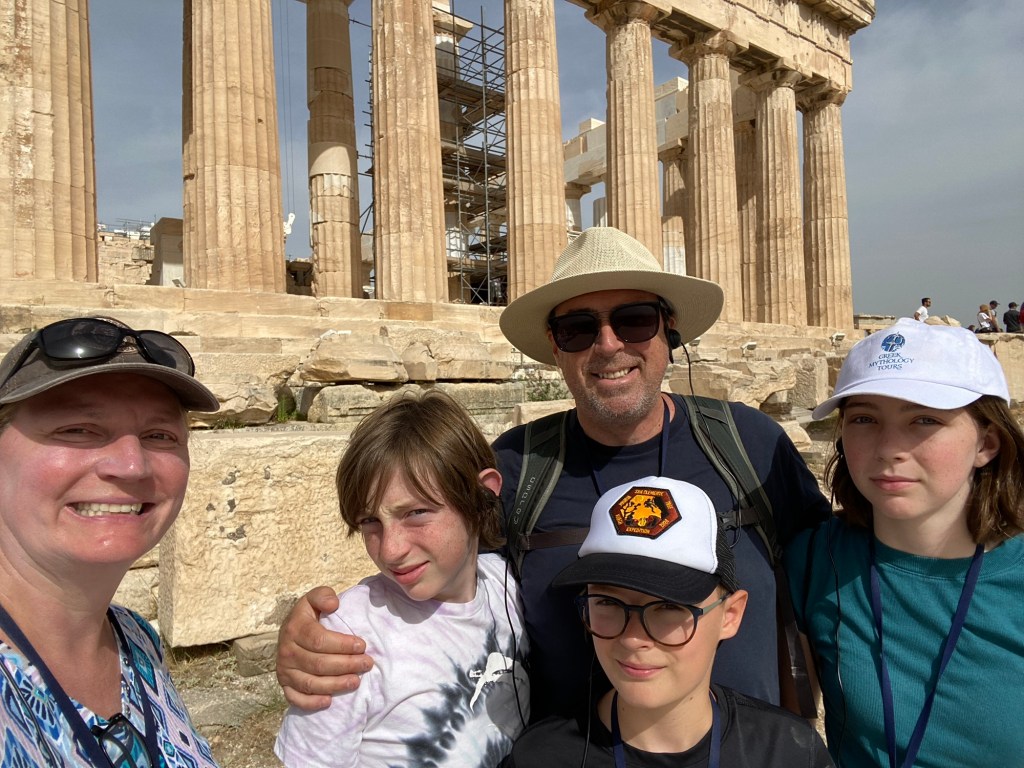
From there we walked around the Parthenon itself. There was scaffolding on the back and work being done inside to stabilize and/or restore the monument. It was blown apart by an explosion with pieces scattered everywhere so it’s been a big jigsaw puzzle to put back together.

The tour that we selected came with a 3D app that showed what the site used to look like. The kids had some fun playing with that.

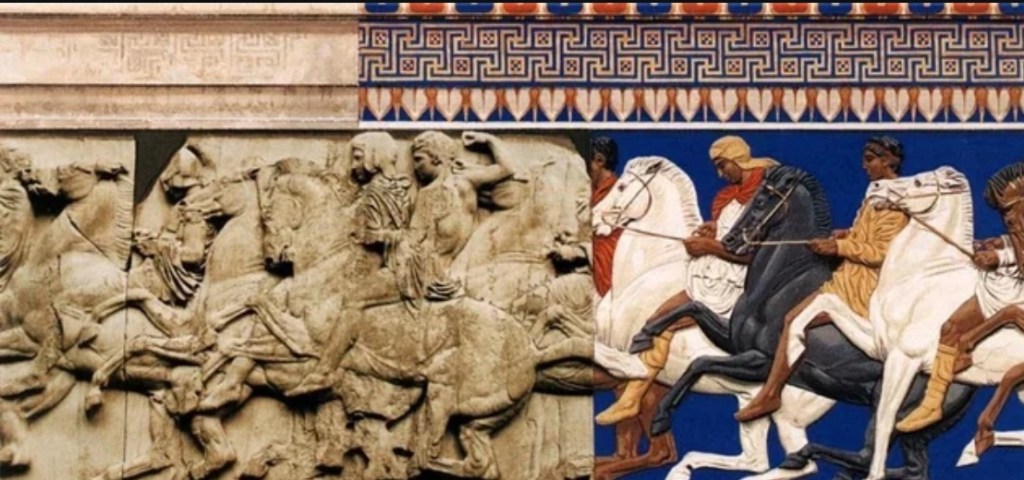
What we never learned before is how colorful it all would have been. Bright blacks and reds and even blue and green would have been on all the surfaces of the statues. It’s strange to see after years of plain white marble in all our textbooks.
Of course, being up high on a hill offers some great views of the first theatre in the world and the modern Acropolis Museum on the background.

We also had a view of the Olympic Stadium, built for use in 1896 for the first modern Olympic Games.
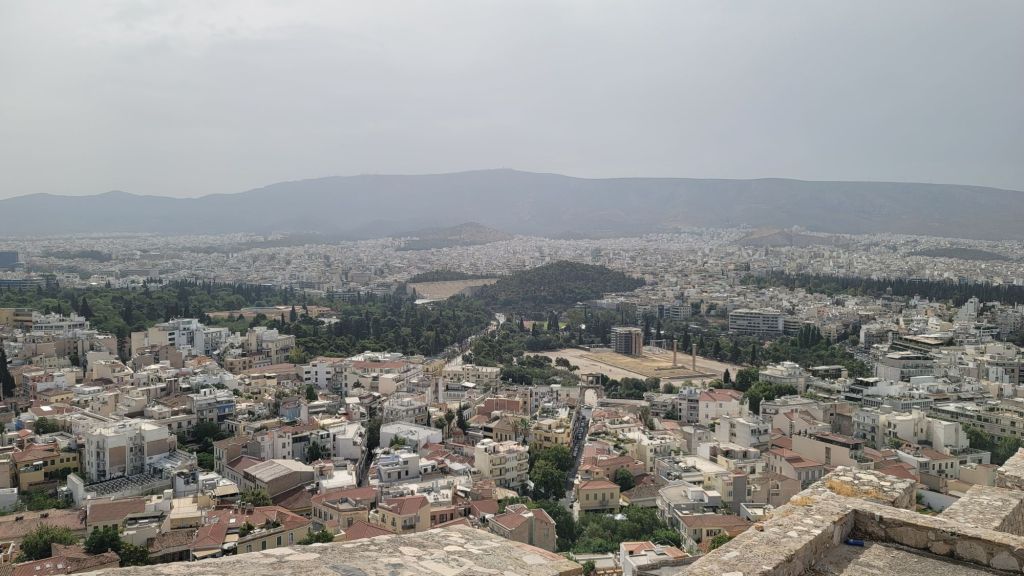
After seeing the Acropolis temple complex and listening to the history of Greece since it was built, it’s pretty shocking that it’s still standing. The Persians burned most of it to the ground, the Byzantines made them turn the Parthenon into a church. The Ottomans made it a mosque. Not until the early 1800’s did the Greeks gain control of their heritage. But in the meantime, the whole world adopted the Classical style for their own architecture. First, the Romans and then the rest of the world. Who hasn’t seen a fluted marble column on some monument, public building, or mansion.
The museum had air conditioning which was its best feature on another 100 degree day. It also had some spectacular statues that had been preserved when the Greeks buried them after the Persian attack. Protected by the dirt for thousands of years, some still retain impressive detail and the original colors.
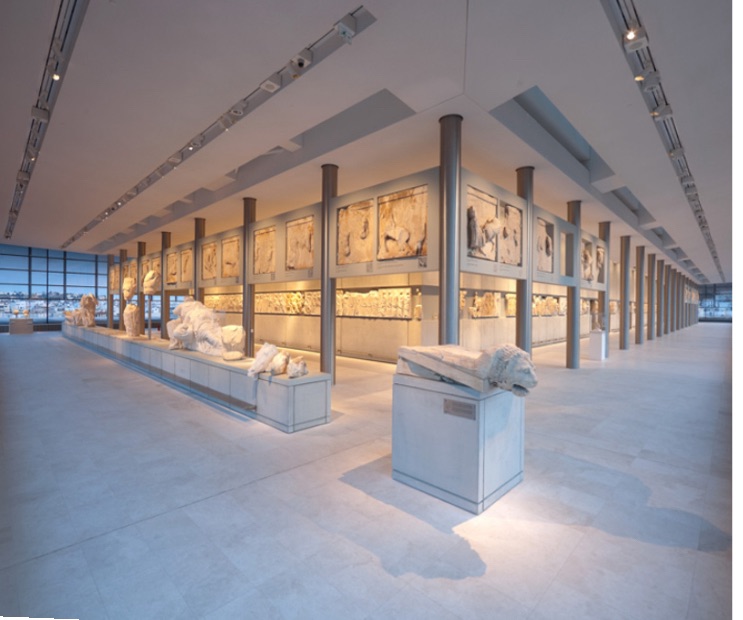
The top floor of the museum is dedicated to the top of the Parthenon. They have created an eye level but faithful recreation of the top four sides of the Parthenon which was covered in carvings and statues. Where they have the originals they are displayed and are amazing even with the ravages of time. Where they don’t have originals, there are spaces or plaster copies of items held in other museums. Rather than being in a glass case along a gallery wall, they are placed in their context, but down the hill and in a protected environment.
We were lucky to see many of the panels and statues when we were at the British Museum – known as the Elgin Marbles – although we only got one photo.
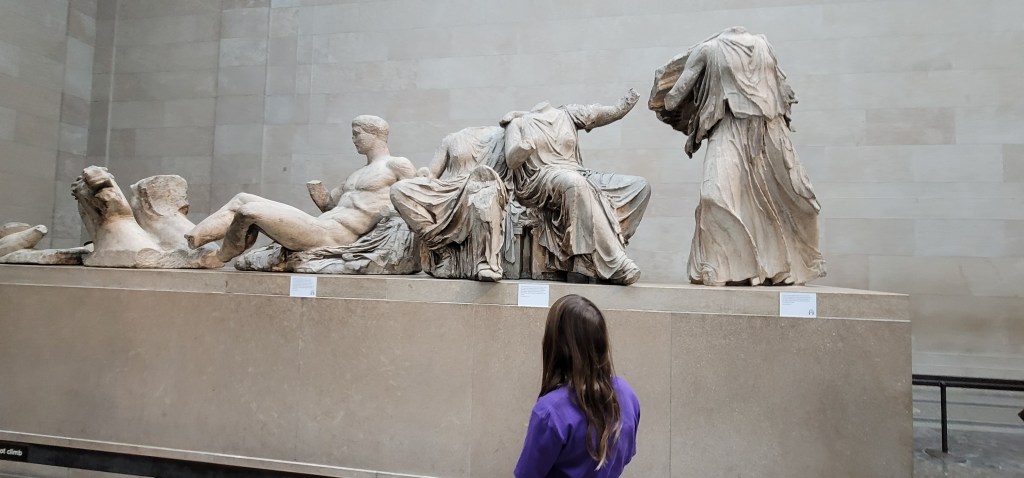
They are stunning. We imagine this room is where they would come if they are ever returned to Greece.
Of course, the kids might say their favorite part of the museum was the Lego version of the Acropolis. To be fair it was impressive.

The actual Acropolis was amazing to see and a highlight from the trip. It was also our last tour of ‘piles of rocks’ for this trip. After the museum we headed back to our apartment to pack and start our travels home. On the way, Tiffany grabbed a couple of classic Greek street snacks – the Koulouri. There are stands selling the sesame covers bread rings everywhere you go but we hadn’t gotten a chance to try one.

It’s crunchy outside, soft inside with a nutty almost sweet flavor. Ours was good and probably several hours past its prime so we’ll definitely put that on the list to have next time our Adventures take us to Greece.
 5 Adventures Together